News
2023: It’s Tinubu vs. Atiku
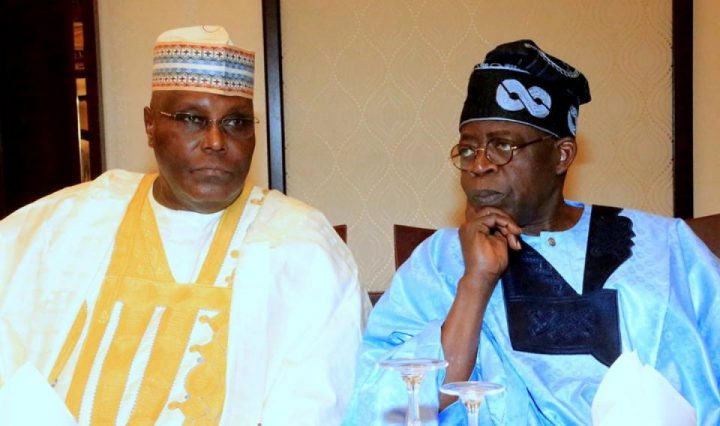
2023: It’s Tinubu vs. Atiku.
Now, the die is cast as the two major political parties are set for the February 2023 presidential election. Following May28 primary election held at the Moshood Abiola Stadium, Abuja, Alhaji Atiku Abubakar, a veteran of such contest won with a little more than 50 per cent of the votes, while Governor Nyesom Wike was second. Atiku polled 371 votes to the Rivers State governor’s 237. Former Senate President Bukola Saraki was a distant third. The other nine aspirants did not poll significant votes, thus paving the way for the emergence of Alhaji Atiku Abubakar as a formidable flag bearer.
Focus then shifted to the ruling party, the All Progressives Congress (APC) where former Lagos State governor, Asiwaju Bola Ahmed Tinubu, had indicated his interest in bidding for the office. When asked why he was dumping the long held position of a king maker for an aspirant in this race, Tinubu said he had the right to change his mind, while also disclosing that it had been his life-long ambition. It was a hint that he would fiercely contest in the shadow election.
Only yesterday, the result of the election that started on Monday was released and Tinubu won with a landslide. He crushed opposition from Vice President Yemi Osinbajo, a Senior Advocate of Nigeria and Professor of Law. Osinbajo was a distant third, while former Minister of Transportation, Rotimi Amaechi, was second. Neither returned any significant votes, as Asiwaju Tinubu received the endorsement of 1, 271 delegates to Amaechi’s 316 and Osinbajo’s 235.
Nigeria’s political history shows that the people have always gravitated towards a two-party system as is the case in many other democracies. In the First Republic when political parties had their roots mainly in the regions of their founders, thus having the Northern Peoples Congress (NPC) in the North, the National Convention of Nigerian Citizens (NCNC) in the East and the Action Group (AG) in the West, within two years, there had been a realignment of forces with two major alliances emerging. A splinter group of the AG in the West, the Ladoke Akintola-led Nigerian National Democratic Party (NNDP) teamed up with the NPC to form a Nigerian National Alliance (NNA). The NCNC and AG also sought a working alliance by forming the United Progressives Grand Alliance. Thus, the first post-independence federal election held in 1964 was fought on the two platforms.
The situation was not much different in the Second Republic when the Federal Electoral Commission (FEDECO) headed by Mr. Patrick Ani registered five political parties- the National Party of Nigeria (NPN), Unity Party of Nigeria (UPN), Nigerian Peoples Party (NPP), Great Nigeria Peoples Party (GNPP) and Peoples Redemption Party (PRP), Before the Republic was inaugurated, there had been an understanding to coalesce into two broad alliances, that is the Progressive Parties Alliance versus the NPN. Even when the PPA broke down, the NPP went into a coalition with the NPN in order to form the government, while the other three parties continued to have a working alliance, especially in the National Assembly. In the Third Republic, it was a more natural two-party system as the Ibrahim Babangida military administration simply decreed two parties, the Social Democratic Party (SDP) and the National Republican Party (NRP) into being.
Since the inception of the Fourth Republic, elections have been contested on two-party basis. In 1999, even though three parties were registered, the All Peoples Party (APP) went into a working alliance with the Alliance for Democracy (AD) before the presidential election, against the more formidable PDP) that obviously enjoyed the support of the military establishment. Since 2014 when the All Progressives Congress (APC) was formed by four legacy political parties, it has gained strength and taken over governance structure from PDP that had boasted it would hold on to power for at least 60 years.
Both men are battle tested, Tinubu who won the election to emerge the first Fourth Republic Lagos State governor, has shown that he is dogged and doughty. He has always had it rough, but won every political contest. Before he could be allowed to fly the AD flag in 1999, he fought a grim battle not only against Mr. Funsho Williams, but a powerful cabal in the party. He triumphed. In office, issues were raised about his educational qualification and age. He defeated his traducers. The PDP-controlled Federal Government seized revenue due the state’s 20 local government councils. The battle was taken to the judiciary and President Obasanjo was ordered to release the funds, Despite refusing the judicial decision, the state government, due to the governor’s ingenuity, could not be crippled.
Alhaji Atiku Abubakar is equally a fighter. He got initiated into partisan politics after he left the Nigeria Customs Service in 1989. He was a pillar of the Peoples Front of Nigeria that was made to merge with the Peoples Solidarity Party to form the Social Democratic Party. He joined forces with Alhaji Babagana Kingibe who was made the party’s first National Chairman and the father figure, Major General Shehu Musa Yar’Adua to give life to the SDP before the June 12, 1993 presidential election. He had locked horns with Chief Moshood Abiola and Kingibe for that party’s ticket at the Jos convention. Abiola won and eventually picked Kingibe as his running mate. Since then, he has left no one in doubt that his ultimate ambition is to be Nigeria’s President.
Alhaji Abubakar was picked as running mate to President Obasanjo in 1999 and subsequently became the Vice President. Within four years, the duo had fallen apart. Insiders say the Vice President would have defeated his boss had he not withdrawn from the 2003 contest at the last minute. He crossed over to the Action Congress of Nigeria (ACN) to contest the year’s election since the President had firm grip of the party structure. All attempts to get him to leave office before the election failed as he defeated President Obasanjo and the PDP in court. He won barely a little more than 2 million votes to PDP’s Umaru Yar’Adua’s 24 million and Muhammadu Buhari of All Nigeria Peoples Party (ANPP) who polled 6.6 million votes. He also contested in 2011, attempted to be the APC’s candidate for the 2015 poll and then moved back to the PDP on whose platform he contested against Buhari as incumbent candidate in 2019.
Both Atiku and Tinubu are no strangers to each other. Indeed, they are political allies, as Tinubu was elected to the Senate in 1992 on the platform of the SDP, a staunch member of the PFN tendency he was, while Atiku was running for President. It was therefore no surprise that Tinubu was swift in congratulating the former Vice President when he won the PDP ticket last week. And, no sooner was Tinubu declared candidate of the APC, Atiku rejoiced with him. How would the two allies turned contenders for the same office tackle each other in the run up to the election? We should expect fireworks from the two septuagenarians. Tinubu has always been a progressive, while Atiku has moved round platforms to realise his ambition.
Both men are known to have heavy war chests. It would be interesting as both deploy their material, financial and strategic resources to fight what could prove to be a tough battle