News
Bandits Sack 100 Southern Kaduna Communities, Force Others Into Negotiations
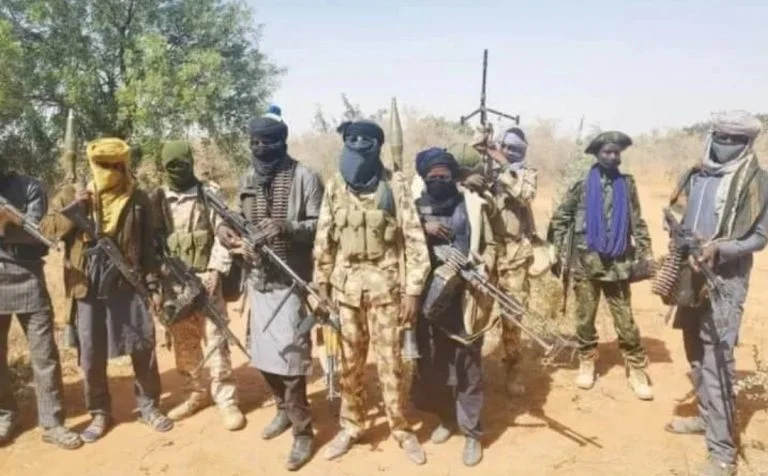
No fewer than 100 communities in Kaduna State have been displaced following incessant attacks by bandits, Saturday PUNCH has learnt.
The affected communities cut across six local government areas of Shiroro, Kachia, Kajuru, Kagarko, Chikun, and Birnin Gwari.
Findings by Saturday PUNCH revealed that the hardest hit communities by banditry include: Aduwa, Ankuro, Akama 1, Gidan Baba Mai Mota, Gidan Yaya, Gidan Waje, Impi Kuturmi, Iriyo, Idebin, Katon Bisa, Kigwali, Kintaro, Kukah, Kurmin Aja, Kurmin Taba, Maigarma, Maraba Barga, Pangyada, Akwana, Tsakiya, Unguwan Alle, Gidan Obere, Dandoka, Tosnin Dodo, Urumo, Takalafiya, Kushinda, Apele and Palapala.
Others are: Ungwan Kuka, Ungwan Pah, Attara, Kurmin Jah, Ankuro, Kurmin Zaki, Ikubiya, Ungwan Lalle, Ungwan Alewa, Dutse, Kigwale, Ariko Village and Ungwan Toka, Baba Maimota, Tsonin Dodo, Gidan Dandoka, Gidan Zamani, Gidan Doigara and Kurmin Taba.
While the National President of the Southern Kaduna Peoples’ Union, Tabara Kato, said more than 100 communities had been displaced, the former spokesman of the association, Luka Binniyat, put the number of affected communities at 245.
Kato disclosed that a total of 35,402 residents had been displaced across the state.
The most recent attack happened on July 26 in Naridon Village in Kamaru Ward, Kauru Local Government Area of the state, where terrorists killed at least 30 villagers, including eight children, during a three-hour raid.
Speaking with Saturday PUNCH, Kato said land grabbing and resource control were responsible for the terror acts.
He alleged that the attacks were carried out by armed attackers sponsored by individuals seeking to force indigenous communities out of their lands and take over areas believed to be rich in mineral deposits.
According to him, several communities had been overrun by the attackers, with some allegedly renamed and now occupied by strangers after residents were displaced.
“So far, more than 100 communities have been displaced. Some of the victims are now living in Internally Displaced Peoples camps. They are living from hand to mouth and at the mercy of the weather, and human and natural hazards.
“The major cause of these attacks is land grabbing. Every other thing is just secondary to it. The attackers are being sponsored by people with the aim of driving the original settlers away and grabbing their land.
“There are some communities that have been occupied by invaders. The violence is just a cover to chase people away from their communities because of mineral deposits and forcefully take over the communities. Some of these communities have been renamed and are now being occupied by strangers,” he said.
Kato urged the Federal Government and security agencies to intensify investigations into the attacks to uncover those financing the violence, insisting that arresting suspects without exposing their sponsors would not end the crisis.
“If the government is serious, they can zero in on these sponsors. Security agencies are best positioned to unravel them through thorough investigations. I just wish the government will have the political will to go after the source of this terrorism so that normalcy and peace can be restored to our communities,” he added.
On his part, Binniyat lamented that the prolonged displacement of thousands of residents had created “a dangerous security vacuum now serving as a haven for terrorists and kidnappers.”
Binniyat, who is also the spokesman for the Middle Belt Forum, expressed concern over the worsening humanitarian crisis in the region, saying the number of Internally Displaced Persons in Southern Kaduna alone had risen to about 150,000.
He said, “As of June 2026, about 245 communities have been sacked by the Fulani ethnic militia across Southern Kaduna. The most affected are communities in Kachia, Kajuru, Kagarko and Chikun Local Government Areas, including some Gbagyi villages in Birnin Gwari.
“When these displaced communities are joined with the boundary communities in Shiroro Local Government Area of Niger State that have also been displaced, they form a contiguous land mass of about 6,000 square kilometres. That is larger than Anambra State and even bigger than Imo State.
“These are now open, ungovernable spaces holding hundreds of Fulani terrorist camps and swelling with hostages.”
Binniyat called on the Federal Government and security agencies to launch a coordinated operation to reclaim the occupied communities, dismantle the camps of armed groups and facilitate the safe return of displaced residents.
He also urged both the Federal and Kaduna State governments to prioritise the rehabilitation and reconstruction of destroyed communities, warning that continued occupation of the affected areas could worsen insecurity across the North-West and North-Central regions.
Peace deal with terrorists
Meanwhile, investigations by Saturday PUNCH revealed that several communities across Kachia Local Government Area of the state have been forced to enter into informal “peace” arrangements with armed groups.
Residents who spoke with one of our correspondents said the arrangements, reached under intense pressure following repeated attacks, have gradually transformed into systems of control in which villagers are compelled to comply with conditions imposed by the armed groups.
Communities identified by residents as having entered into such arrangements include: Gidan Dogo, Ungwan Luka, Maikasuwa, Item, Maidorafi, Maidokufai, Mai-Goro, Gizago, Pachi, Ungwan Ranapachi, Akuru, Gidan Hassan, Gidan Ali, Aburon, Kabaude, Potai, Gidan Gaskiya, Gidan Audi, Banikanwa, Gabaciwa, Gidan Akau, Inugu, Gidan Gajere, Atufa, Gidan Burgs, Impi Kadara, Impi Kuturmi, Sabo Vida and Ungwan Gimba.
The residents said the conditions attached to the arrangements differ from one community to another, but many described recurring demands for money, restrictions on movement, compulsory labour and other forms of coercion.
Speaking with Saturday PUNCH, a resident of Mai-Ido Kufai, Jessy Francis, said the worsening insecurity forced some community leaders and residents to go into negotiation with the armed groups with the hope that normalcy would be restored in the communities.