News
National Assembly Advances State Police Bill Amid Rising Security Challenges
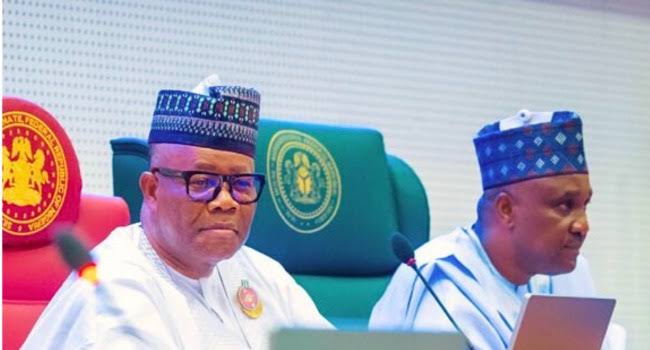
Nigeria’s push for decentralized law enforcement has moved closer to reality following significant legislative progress in the National Assembly. Both the House of Representatives and the Senate have taken decisive steps toward amending the 1999 Constitution to allow for the creation of state police formations.
In a major milestone, the House of Representatives passed the constitution alteration bill after a definitive plenary vote. Out of 290 lawmakers present meeting the required two-thirds constitutional quorum 289 members voted in favor of the bill, while only one voted against it. Speaker Tajudeen Abbas, who oversaw the process, noted that the piece of legislation is a crucial step toward establishing a security framework tailored to local realities while safeguarding national sovereignty.
Concurrently, the bill successfully scaled its second reading in the Senate. Senate Leader Opeyemi Bamidele, who led the debate, emphasized that localizing law enforcement would significantly improve intelligence gathering, as personnel from local communities are far better positioned to navigate regional languages, terrain, and social structures.
Key Structural Changes and Safeguards
The proposed legislation consists of 18 clauses designed to move policing from the Exclusive Legislative List to the Concurrent Legislative List. This shift grants state governments the legal authority to establish, fund, and manage their own security outfits alongside federal forces.
The legal framework outlines clear distinctions between federal and state jurisdictions:
Establishment & Standards: States cannot launch a police force unless it is established by a State House of Assembly law and certified by the federal government as meeting national minimum standard benchmarks.
Federal Intervention: The Federal Police will retain complete authority in the Federal Capital Territory (FCT). They are explicitly barred from interfering in internal state policing matters except during a total breakdown of law and order where state forces are overwhelmed, or if a state governor formally requests intervention.
Administrative Overhaul:The existing Police Service Commission will be replaced by the Federal Police Service Commission, and the Nigeria Police Council will transition to the National Police Council. The term “Nigeria Police Force” will be legally replaced with “Federal Police and State Police.”
To mitigate fears regarding potential political abuse by state governors, the bill introduces stringent mechanisms for appointing and removing top officials. A State Commissioner of Police will be appointed by the Governor on the advice of the National Police Council, subject to confirmation by the State House of Assembly.
Furthermore, removing an Inspector-General of Police or a State Commissioner of Police will require a recommendation from the National Police Council based on explicit grounds like grave misconduct, followed by a two-thirds majority legislative approval.
Mixed Reactions and Fiscal Concerns
While the bill enjoys broad legislative backing, it has sparked intense debate among security experts and retired law enforcement officials.
Supporters, including retired Assistant Inspector General of Police Ali Amodu, argue that the operational benefits of a decentralized system heavily outweigh potential flaws, noting that mature federations globally operate multi-layered police structures successfully. Some analysts have also suggested that the transition could be streamlined by redeploying serving police officers back to their states of origin.
Conversely, critics raise serious warnings regarding financial sustainability and operational overlap. Retired Commissioner of Police Ladodo Rabiu opposed the move, questioning how state governments many of which struggle to meet basic civil servant salary obligations will fund the immense logistical costs of arms, ammunition, and dedicated training colleges. Concerns were also raised regarding potential jurisdictional clashes between state and federal units during active field operations.
Parallel Defense Spending Surge
The legislative push coincides with newly released data from the National Bureau of Statistics (NBS), which reveals that Nigeria’s formal arms imports surged by 48 percent year-on-year. Expenditure grew to ₦32.5 billion in the first quarter of 2026, up from ₦22 billion during the same period in 2025.
Security analysts view this financial surge as a necessary reaction to multifaceted security challenges ranging from banditry and terrorism to communal clashes unfolding across various geopolitical zones.
Experts urge that alongside increased weapons procurement, the federal government must simultaneously scale up personnel training, domestic production via the Defence Industries Corporation of Nigeria (DICON), and surveillance capabilities to fully secure the nation.