News
UN Chief Warns Middle East Conflict Spinning Out of Control, Threatening Global Economy
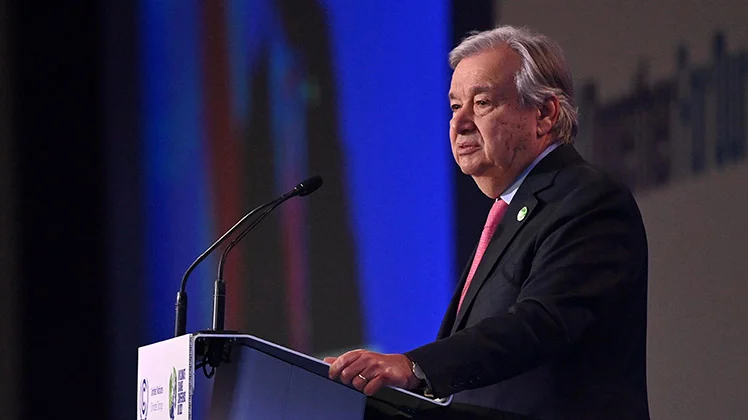
The United Nations Secretary-General has issued a stark warning that the escalating conflict across the Middle East is in danger of spiraling beyond control, posing a serious threat to the global economy. His remarks come as military strikes and counter-strikes continue for a seventh day, fueling a rapidly widening regional crisis.
In an official statement released on Friday, António Guterres expressed deep concern over the intensified fighting between the United States and Israel on one side and Iran on the other, which has now spread across multiple fronts. He urged an immediate halt to hostilities and a return to diplomatic negotiations.
“All the unlawful attacks in the Middle East and beyond are causing tremendous suffering and harm to civilians throughout the region – and pose a grave risk to the global economy, particularly to the most vulnerable people,” Guterres said. “The situation could spiral beyond anyone’s control. It is time to stop the fighting and get to serious diplomatic negotiations. The stakes could not be higher.”
UN Officials Warn of Far-Reaching Consequences
Senior UN humanitarian officials have echoed the Secretary-General’s concerns, warning of cascading effects far beyond the region’s borders. Emergency Relief Coordinator Tom Fletcher described the current moment as one of “grave peril,” pointing out that vast resources are being funneled into the war effort while critical humanitarian operations elsewhere remain severely underfunded.
“Staggering amounts of money are funding the war, while politicians continue to boast about cutting aid budgets in greatest need,” Fletcher told reporters in New York.
He cautioned that disruptions to key maritime routes could lead to a spike in global food prices, strain health systems, and severely complicate humanitarian work worldwide. “What we need is de-escalation and immediate cessation of hostilities, genuine dialogue and negotiations,” he added.
The UN refugee agency (UNHCR) has declared the escalating situation a major humanitarian emergency requiring an urgent regional response. Meanwhile, UN human rights chief Volker Türk warned that the conflict is expanding beyond the initial parties involved and called on all states to take immediate steps to de-escalate the violence.
Strategic Shipping Lane Under Threat
The conflict is increasingly impacting global trade, particularly in the Strait of Hormuz, a strategic waterway at the entrance to the Persian Gulf through which approximately 20 percent of the world’s oil passes.
Arsenio Dominguez, Secretary-General of the International Maritime Organization (IMO), confirmed that the strait is effectively closed due to the threat of attacks. He reported that a tugboat assisting another vessel in the strait was struck on Friday morning, resulting in the deaths of four seafarers.
Dominguez described the overall situation as “deteriorating” and advised ships to avoid the region. He warned that an estimated 3,000 vessels and around 20,000 seafarers are currently stranded in the area, with the disruption to this critical corridor likely to have significant global “knock-on” effects. He called on member states to “find solutions through dialogue in order to de-escalate” and restore safe navigation.
Iran States It Does Not Seek War
Speaking to reporters outside the Security Council on Friday, Iran’s Permanent Representative to the UN, Amir Iravani, stated that Tehran does not want further escalation but will firmly defend its sovereignty.
“Iran does not seek war or escalation, but Iran will never surrender its sovereignty,” Iravani said, adding that the country would take all necessary measures to protect its territory and independence.
He called on UN Member States to condemn what he termed a “criminal war against the Iranian people” and urged the Security Council to “act now, firmly, clearly and without delay – failure to act will have catastrophic consequences. Today it is Iran, tomorrow it could be any other Member State.”
Humanitarian Toll Worsens Across Region
On the ground, humanitarian conditions continue to deteriorate. In Lebanon, mass displacement is ongoing amid evacuation orders and continued airstrikes. In aza, UN officials report that civilians and civilian infrastructure remain under threat from airstrikes, shelling, and gunfire.
According to UN spokesperson Stéphane Dujarric, while the Kerem Shalom crossing remains open for approved humanitarian supplies, other key crossings, including Rafah, are closed. This has suspended medical evacuations, the return of residents from abroad, and staff rotations for humanitarian workers.
Aid agencies inside Gaza are prioritizing emergency health care, maternal and neonatal services, and trauma treatment, all while operating with limited fuel supplies. In the West Bank, expanded checkpoint closures and settler violence are further restricting Palestinian access to essential services and livelihoods.
Despite the deteriorating security environment, UN officials confirm that humanitarian teams continue to operate across the region, as international calls intensify for an immediate halt to the fighting and a return to the negotiating table.