News
War-scarred Gazans observe sombre Eid as soaring prices, shortages erase festive cheer
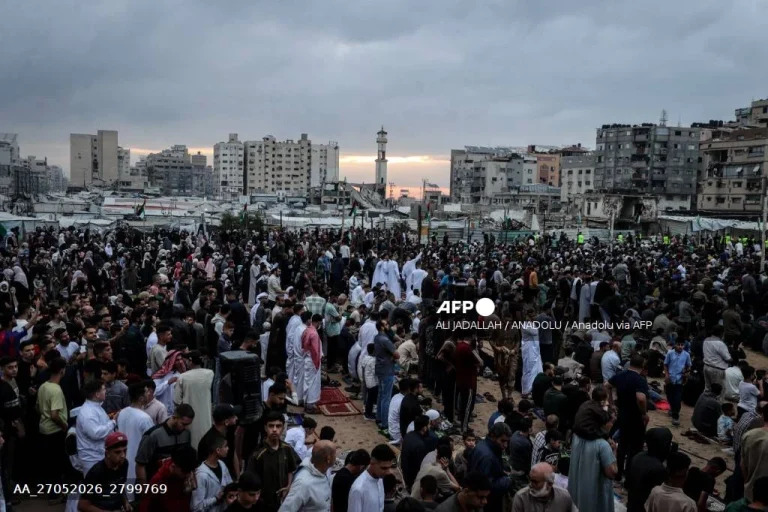
Palestinians in Gaza marked Eid al-Adha on Tuesday without the traditional feasts and new clothes that once defined the celebration, as war-induced poverty and severe shortages deepened suffering across the territory.
Displaced from northern Gaza to Deir al-Balah for over two years, 40-year-old Nadia Abu Shamala said she visits the market only to look around because she cannot afford anything. “Whenever I ask about prices, I return heartbroken,” she said. “This year, Eid comes with none of the joy we once knew in Gaza because of the war, the soaring prices, and our inability to provide even the simplest needs for our children.”
Despite a US-brokered ceasefire that took effect in October 2025, Israeli air strikes remain frequent. According to the United Nations, 80 per cent of buildings in Gaza were damaged during the conflict, and most of the population relies on aid for survival. Aid agencies say Israel’s tight control over entry points keeps the flow of goods too low to ease war-inflated prices.
Central to the Eid al-Adha ritual is the sacrifice of a sheep, but livestock cannot enter Gaza. Only about 15,000 sheep remain for the coastal enclave’s 2.1 million people a quarter of the pre-war herd the UN’s Food and Agriculture Organisation estimates.
Raafat Asaliya, a spokesperson for Gaza’s agriculture ministry, said sacrificial animals are witnessing an unprecedented price surge due to limited supply, rising breeding and feed costs, and the shutdown of many farms. He noted that a sheep that sold for around 1,000 shekels before the war now costs between 11,000 and 15,000 shekels.
Ahmed Abu Salem, a Gaza City resident, said families like his who performed the sacrifice every year can no longer afford even a kilogramme of meat. “We have never heard of such prices in our lives,” he said.
A former property dealer from a well-established central Gaza family, 59-year-old Abu Abdullah al-Mosadar, pooled about 13,000 shekels ($4,570) with his brother to buy a sheep. “I know it is very expensive, but I decided to perform the sacrifice this year,” he said, adding that he hopes to restart his construction and real estate business if conditions allow.
Cooking at home has also become a struggle. Displaced with his family in southern Gaza, 42-year-old Abu Ahmed Wafi said the markets are full of holiday sweets but families cannot bake their own because cooking gas is unavailable and prices have risen sharply.
In Khan Yunis, one family prepared trays of maamoul, the traditional Eid biscuits, under a makeshift shelter covered with a reused UNICEF tarp. A woman and her daughter shaped the dough on the ground while a man baked them in a clay oven.
From her tent in Deir al-Balah, Shamala summed up the mood of many. “We are still living in tents with no atmosphere of joy, only worries, fear, and exhaustion, without any of the happiness we once knew.”