News
Widespread Vote-Buying Allegations Shadow Ekiti Governorship Election
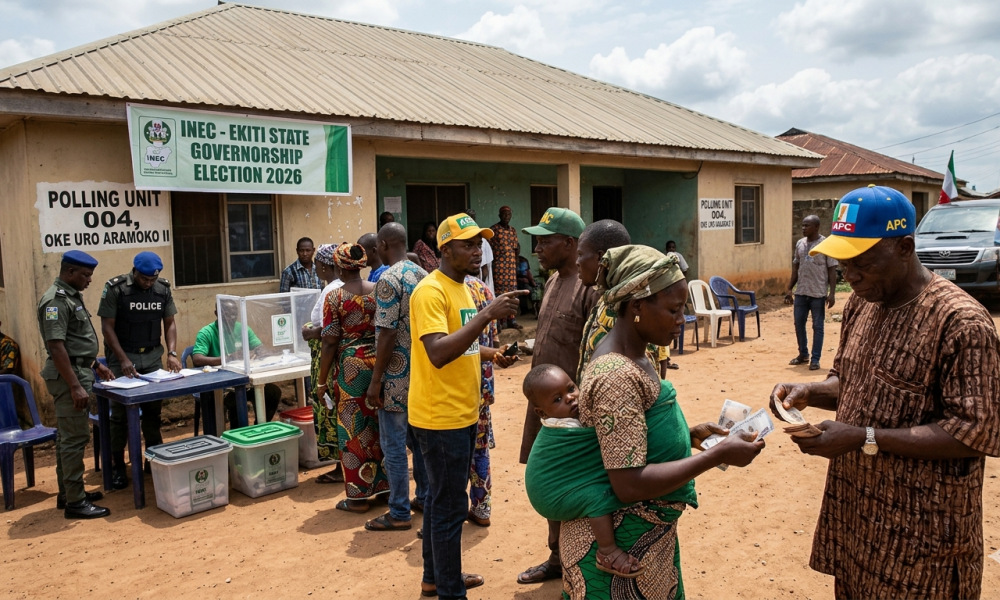
Fresh evidence of widespread voter inducement has surfaced in the ongoing Ekiti State governorship election, with multiple voters openly admitting to receiving cash payments in exchange for their votes. The transactions are reportedly occurring within close proximity of polling units, despite a heavy deployment of security personnel and anti-graft officials across the state.
During field monitoring in Aramoko Ekiti, several voters confirmed that they were offered and accepted cash payouts to influence their ballots. In separate accounts, multiple individuals disclosed receiving ₦10,000 each to cast their votes for the ruling All Progressives Congress (APC).
The open nature of the cash distribution was particularly visible at Polling Unit 004, located at Chief Ologbodo’s House in the Oke Uro area of Aramoko II. At the site, party operatives were observed aggressively soliciting voters. Representatives associated with the APC allegedly offered ₦10,000 to secure votes for the incumbent governor, Biodun Oyebanji, while agents representing the opposition African Democratic Congress (ADC) were reportedly offering ₦2,000 per voter.
These developments follow an earlier high-profile deployment by the Economic and Financial Crimes Commission (EFCC). Around 9:05 a.m. on Saturday, a team of approximately ten EFCC operatives stormed Governor Oyebanji’s immediate polling unit Polling Unit 003, Ward 06, Ikogosi in the Ekiti West Local Government Area following preliminary intelligence regarding illegal financial flows. While the anti-graft officials established a strict perimeter to monitor the voting process, no immediate arrests were made at the scene.
The Independent National Electoral Commission (INEC) and various civil rights coalitions had previously issued stern warnings that vote-buying would be heavily penalized. However, compliance remains inconsistent across the state’s 16 local government areas, as party operatives and voters continue to engage in transactional voting, seemingly undeterred by the regulatory oversight.