News
CIOTA:Stakeholders call on govt to fund transport infrastructure for growth
Chartered Institute Of Transport Administration of Nigeria, CIOTA, has been enjoined to enlighten governments at all levels especially local government tiers on the need to use proceeds from oil subsidy removal to develop intermodal transportation.
Professor Iyiola Oni, Director Centre For Multimodal Transport Studies, University of Lagos made this remark on Monday while presenting a paper at the Chartered Institute of Transport Administration of Nigeria, South West Zonal Conference held at Nigeria Institute of Madical Research, Yaba, Lagos.
He urged that the Institute to leverage on the autonomous status granted Local government councils through the recent Supreme Court Judgement, to advocate that local governments should invest in development of road infrastructures in order to reduce impact of oil subsidy removal.
Oni stated that local government tiers of government are closer to the grassroots and are in better position to know and address the road infrastructural needs of the people
In a paper presentation themed: “The Role Of Transport And Logistics In Sustainable Development”, he said that as much as Federal and state governments have responsibility to repair and maintain the roads, the Local governments own 60% of the roads and should fix same especially now that revenue is allocated directly to them from the federation account.
Oni advised federal and state governments to desist from the approach of purchasing and distributing rice and beans as palliatives which seldom reach the vulnerable advising that revenue accruing from oil subsidy removal should be used to develop critical sectors like health, education and particularly transportation.
He explained further that development of all the modes of transportation will enhance movement goods, service and commuters from one location to another and by extension boost economic development.
According to him, the level of accessibility of people to various modes of transportation from one location to another determines the level of of development of a country
President, CIOTA, Prince Segun Obayendo in his remarks at the conference noted that transportation is backward today due to lack of proper regulation and professionalism.
“There should be standards and certification for people who intend to operate transport business and not the present trend whereby people that lost their jobs dabble into transport business without any restriction.
“If transportation is regulated and enforced attitude of motorists will change because people who park and overtake indiscriminately will be penalised”, he declared.
The President stated categorically that there should be terms and conditions before becoming a transporter and not the present free entry and exit leading to chaos in the transport system.
He opined that adequate regulation and enforcement will reduce recklessness and accidents on our roads adding that government should evolve a National Transport Policy so that all stakeholders will know their boundaries.
While calling on other states to emulate Lagos state in the development of intermodal transportation, Obayendo commended Lagos Lagos State Traffic Management Authority for maximal deployment of technology in traffic management through establishment of control tower to monitor traffic in the state.
Chairman, Lagos State Chapter, CIOTA, Dr. Taiwo Salaam in his welcome address said transport and logistics are the backbone of any economy, serving as the veins through which the lifeblood of commerce, industry, and social interaction flows.
He however noted that the world is changing rapidly, and so must our strategies and approaches adding that the role of transport and logistics must evolve to meet the demands of a future that prioritizes environmental stewardship, economic resilience, and social equity.
Group Captain John Ojikutu (Rrtd), in his presentation noted that the present focus should be on intermodal transportation.
He acknowledged efforts of Lagos state government in building infrastructure to boost intermodal transport but that the yellow buses, taxies and “Keke Marwa” are not properly regulated leading to indiscriminate parking on the roads.
In the case of aviation mode of transportation, Ojikutu posited that in the last 40 years there has not been any serious development in the Nigerian aviation sector.
He stated that despite financial interventions by the Obasanjo, Yar’Adua/Jonathan administration’s most of the airlines that benefitted are now defunct.
He decried opinions in some quarters that government should float a National Carrier saying, “Government should create a conducive environment for one of the existing viable private airlines with enough fleet to carry the nations flag”.
According to Ojikutu the flag carrier can fly internationally to any part of the world instead of the present trend whereby 80% of revenue in commercial is generated by foreign airlines.
He pointed out that out of the 22 airports existing in the country only three including Nnamdi Azikwe, Abuja, Murtala Muhammed, Lagos and Port-Harcourt International Airport are viable while others are providing skeletal services.
Ojikutu enjoined states in the South-west for instance to pull their resources together to establish a central airport within the region adding that How many passengers currently fly to Ibadan
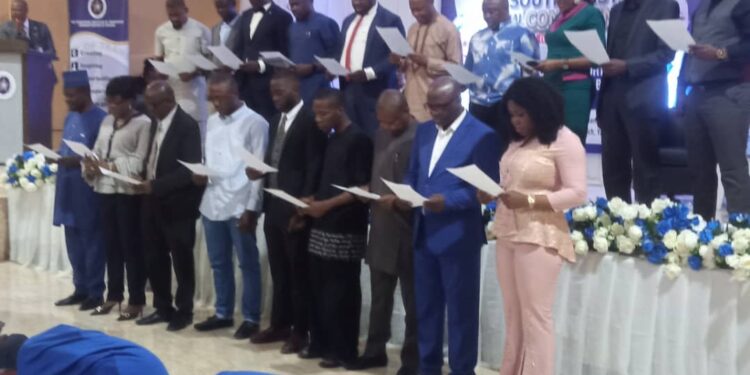
The Institute also presented awards of recognition to some outstanding members while others were inducted as fellows and members during the conference.