News
Court Orders Stripping of Trump’s Name From Washington Arts Center
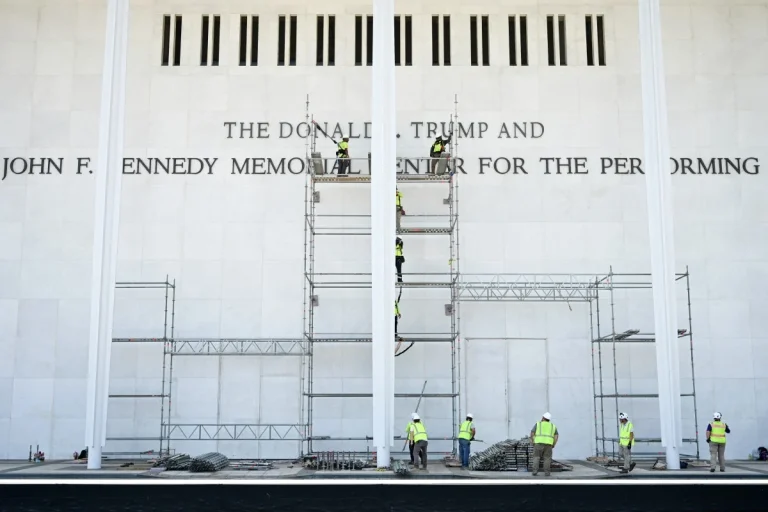
Maintenance crews in the United States capital have removed the name of President Donald Trump from the facade of the John F. Kennedy Center for the Performing Arts, enforcing a federal court mandate that declared the building’s recent rebranding illegal.
The physical removal of the signage took place during a predawn operation on Saturday after a federal judge dismissed a sequence of emergency appeals filed by the administration and the venue’s governing board. By midday, workers on scaffolding under a white protective tarp had successfully dismantled the prominent exterior lettering.
The legal standoff trace back to late last year, when the institution’s governing board largely populated by presidential loyalists voted to alter the venue’s title to the “Trump Kennedy Center,” formally appending “The Donald J. Trump and” above the original name engraved on the landmark’s marble exterior. The unilateral move triggered instant pushback, prompting a lawsuit from board member and Democratic U.S. Representative Joyce Beatty, alongside cancellations from several scheduled performers.
In a definitive ruling issued on May 29, U.S. District Judge Christopher Cooper stated that the independent renaming of the cultural landmark violated federal law. The court affirmed that because the complex was established by an act of Congress as a living memorial to the late President John F. Kennedy, only the legislative branch holds the constitutional authority to alter its designation.
The administration was granted a 14-day window to eliminate Trump’s name from all digital platforms, internal materials, and physical infrastructure. While the venue altered its official website and public-facing digital assets earlier in the week, federal attorneys launched a last-minute bid to stall the physical adjustments on the building itself.
The Department of Justice requested a temporary stay of the order on Friday and subsequent 12-hour operational extensions, citing logistical disruptions caused by evening thunderstorms. Judge Cooper firmly denied the appeals, stating that the public interest is not served by extending unlawful governmental actions. A parallel request sent to the U.S. Court of Appeals for the District of Columbia Circuit was similarly rejected.
The judicial rebuke extends beyond the exterior signage. The court has also issued a temporary injunction blocking an executive directive to completely shutter the arts complex for a planned two-year renovation cycle, which was slated to begin in July.
The ongoing disputes over the cultural venue highlight a broader, highly contentious campaign by the current administration to integrate the president’s name, brand, and likeness into the historic and administrative architecture of Washington.
Similar initiatives have successfully placed large promotional banners outside the Departments of Justice and Agriculture, rebranded the former U.S. Institute of Peace, and prompted structural overhauls within the White House complex itself.