News
NEC Adopts 112 as National Emergency Number, Releases Police Training Funds
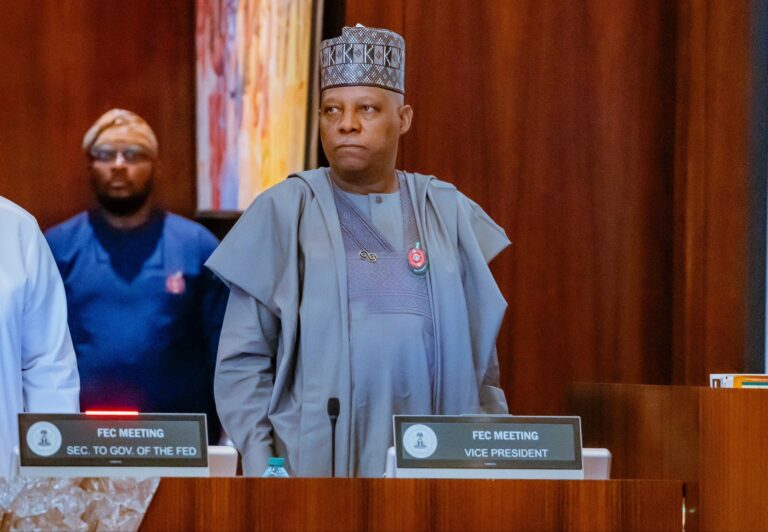
The National Economic Council (NEC) has approved the adoption of 112 as Nigeria’s national emergency number to strengthen coordination and improve response to crises across the country.
This is according to a State House press release issued by the Senior Special Assistant to the President on Media and Communications, Office of the Vice President, Stanley Nkwocha, following the 157th NEC meeting held virtually and chaired by Vice President Kashim Shettima.
The council said the move is aimed at creating a unified and efficient emergency response system across all levels of government and relevant agencies.
It also approved the establishment of a multi-agency implementation committee to drive the initiative, with coordination led by the Office of the Vice President and the Nigerian Communications Commission (NCC).
Speaking during the meeting, the Vice President stressed the urgency of a functional emergency response system, noting that Nigerians require swift action rather than bureaucratic delays in times of crisis.
“This is not only a technical reform. It is a test of the state’s humanity. In moments of fire, accident, robbery, medical emergency, flood, violence, or panic, citizens do not need bureaucracy.
“They need response. They need to know one number to call, one system to trust, and one coordinated chain of action that moves quickly enough to save lives,” he said.
Shettima added that while the 112 number already exists, the priority now is to ensure proper coordination, public awareness, and institutional ownership.
“What is required at the moment is coordination, adoption, standard operating procedures, public awareness, institutional ownership, and trust,” he stated.
The council also directed the Ministry of Finance to expedite the release of approved funds for the rehabilitation of police training institutions nationwide, following a presentation by an ad hoc committee led by Enugu State Governor Peter Mbah.
NEC further emphasised the need for equitable distribution of the rehabilitation projects across all geopolitical zones.
On public health, the council approved the expansion of its ad hoc committee on polio eradication to include seven additional high-risk states, Jigawa, Kaduna, Bauchi, Niger, Yobe, Borno, and Adamawa, to strengthen oversight and accelerate progress toward eliminating the disease.
The council also received updates on key government accounts, including the Excess Crude Account, which stood at $535,823.39, the Stabilisation Account at N72.84 billion, and the Natural Resources Account at N158.19 billion as of April 27, 2026.
In the area of culture and tourism, NEC approved a proposal for sub-national governments to contribute N200 million each toward the implementation of the Renewed Hope Cultural Project and “Naija Season,” a national platform designed to promote tourism, festivals, and creative economy activities across the country.
Council noted that the initiative is expected to generate up to one million jobs by 2030, boost diaspora engagement, and strengthen Nigeria’s global cultural influence.
On industrial development, the council was briefed on the implementation of the National Industrial Policy (NIP) 2025, which targets key sectors such as agro-allied industries, solid minerals, oil and gas, and pharmaceuticals, with a focus on boosting exports and job creation.
Vice President Shettima urged council members to prioritise decisions that deliver tangible benefits to citizens, stressing that governance must translate into real impact.
“History will not ask how many meetings we held. It will ask what changed because we met,” he said.